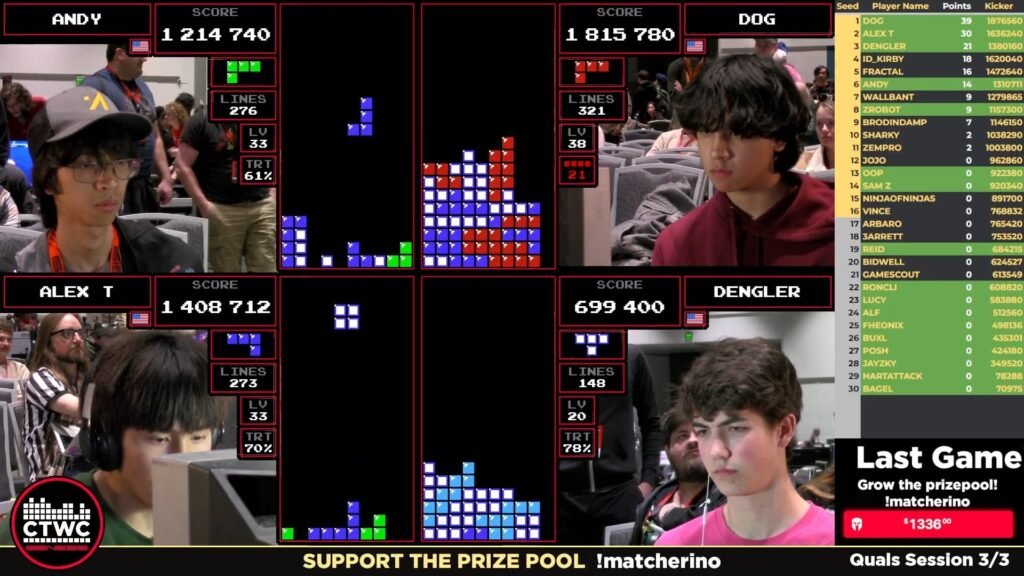
The Classic Tetris World Championship (CTWC) will debut a new qualifying format for the 2026 tournament. After experimenting with different qualifying formats across different regionals throughout the years, organizers have picked a qualifying format that reflects the way matches are being played.
Ultimately, they went with a qualifier point system, inspired by the “Classic Tetris Wars (CTW) format”, where players are rewarded for scores far beyond a maxout under the Level 39 Super Killscreen.
Under the Qualifying point system, scores at or above a maxout (999,999) are worth a certain amount of points. All qualifying sessions will be 90 minutes instead of 2 hours (120 minutes).
For the first time, players will be using a modified cartridge in the Qualifying round, where scores are uncap allowing the game to show scores beyond a maxout and there will be a Level 39 Super Killscreen. Just like the cartridges used in CTWC matches.
After Qualifying ends, players will be seeded by the number of qualifying points earned and their highest score (kicker) will be used as a tiebreaker.
Here is the qualifying point breakdown that will be used at 2026 CTWC
- 0-999,998: 0 points
- 999,999-1,099,999: 2 points
- 1,100,000-1,199,999: 3 points
- 1,200,000-1,299,999: 4 points
- 1,300,000-1,399,999: 5 points
- 1,400,000-1,499,999: 6 points
- 1,500,000-1,599,999: 7 points
- 1,600,000-1,699,999: 8 points
- 1,700,000-1,799,999: 9 points
- 1,800,000-1,899,999: 10 points
- 1,900,000-1,999,999: 11 points
- 2,000,000 and above: 13 points
Under the CTWC version of the point system, a score of 2,000,000 earns you 2 additional points, instead of 1 additional point. Other than that, CTWC point system is the same as the CTW point system, where every 100K above a maxout earns a player 1 additional point.
History of Qualifying Formats at Classic Tetris World Championship
In the first 2 years, Classic Tetris World Championship was a one-day event, which meant that there was not a lot of time available in the Qualifying round. So players were playing very short games to determine seeding.
Qualifying consisted of players playing on B-Type, Height 0. Basically, players had to score as many points as they could within the 25-line limit, where the game ended after clearing 25 lines.
When the Classic Tetris World Championship was held at the Portland Retro Gaming Expo in 2012, it allowed the tournament to be a 2-day event. (CTWC would continue to be held at Portland Retro Gaming Expo until CTWC relocated to SoCal Gaming Expo in 2024)
Qualifying was on Day 1, bracket matches were on Day 2. With a full day of Qualifying, players play on A-Type, where they keep playing until they top out because there was no line limit. Just like the games played in a CTWC match. Players waited in line until a game station was open, and then they played one game and got back in line.
The Qualifying format used the multiple maxout rule, where players were seeded by number of maxouts achieved in Qualifying, with their highest non-maxout score (kicker) used as a tiebreaker.
In the early years, seeding mostly came down to the highest scores that the players achieved because maxouts in Qualifying were rare.
The 2020 and 2021 CTWC was held online because of the Covid-19 Pandemic. Qualifying during the online years consisted of a 2-hour session where players had unlimited game attempts within the time limit. The multiple maxout rule remained as it did a good job measuring a player’s consistency at getting high scores before the Rolling technique really dominated the tournament.
When CTWC returned to an in-person tournament in 2022, the way players qualified changed from the last in-person event in 2019. Instead of waiting in line, players signed up for a 2-hour session, just like the online years. The multiple maxout rule continued.
The line format would have caused players to have to wait 30 minutes or more to play one game, that’s what happened in 2019. That’s why organizers got rid of the line.
This qualifying format would remain the same, with the 2025 CTWC being the last year to use the multiple maxout rule.
Changing the Qualifying Format for Classic Tetris World Championship 2026
Right after the 2025 CTWC, there were discussions about changing the qualifying format.
The first thing that changed was decreasing the session time from 2 hours to 90 minutes. Having a 2-hour session was too long for the players. For rollers, there was an increased risk of injury having to play multiple games for 2 hours non-stop. The Qual format heavily penalized players that took breaks in a race to get the most maxouts. Also, some players, including me, felt fatigued after 90 minutes.
With the issue of session length dealt with, the next discussion was getting rid of the multiple maxout rule. That format was used since 2012 because qualifying stations used vanilla cartridges (unmodified cartridges) where the score counter caps at the maxout score of 999,999. CTWC Organizers would have to create 25 modified cartridges if they wanted uncapped scores and a Level 39 Super Killscreen in the Qualifying round. It is a lot of work to create those modified cartridges so organizers wanted to make sure it was worth it to change the qualifying format.
When rolling became the dominant playstyle at the Classic Tetris World Championship in 2022, players were playing far beyond the Level 29 Killscreen, allowing them to score points far beyond the maxout score. Since 2016, players competed in matches using modified cartridges that allowed them to compete using the same piece sets and uncapped scores. In 2023, a Level 39 Super Killscreen was implemented in CTWC matches to prevent games from going on indefinitely.
Rolling broke the game and pushed CTWC to change how competitions are done. Throughout the years of CTWC under the rolling era, it became clear that they had to get rid of the multiple maxout rule in quals. That format did not accurately reflect how well players would do in tournament play, because it did not necessarily take into account how well a player would do at Level 29 speeds. In tournament matches nowadays, players had to score far beyond a maxout by scoring high on Level 29 play to win the tournament. So the organizers were set to get rid of the multiple maxout rule, they had to figure out what to change it to.
One of the popular formats was a 90-minute session, AO3, where the player’s Top 3 scores were averaged out to determine their final qualifying score. This is currently used at Classic Tetris Monthly (CTM). The format favored players that could score high on Killscreen play, although it didn’t measure how consistent a player was. It was still considered for 2026 CTWC. But there were other qual formats out there, some that were experimented at CTWC Regionals.
CTWC Philadelphia (Philly) Regional had experimented with the multiple 1.2 million rule in 2024 and 2025, where players were seeded by number of 1.2 millions in quals. CTWC Minneapolis Regional did a similar qual format in those same years by implementing the multiple 1.3 million rule, leading to their tournament to be called MinneD on the Screen. These formats did require Level 29 Killscreen play, but the 1.2 million and 1.3 million scores were still attainable by rollers by lining it out on Killscreen.
Later on, 2025 CTWC Space City Regional became the first regional to use the Classic Tetris Wars (CTW) format in Qualifying. It was met with positive reviews by players. Some players had been advocating for this format before the regional. Classic Tetris Wars format works well with determining a seeding rank that reflects the player’s skills in competition because it rewards high scores from Level 29 Killscreen play, while measuring consistency.
Origin of the Classic Tetris Wars (CTW) Format
Grand Designs (Tetris Player and Commentator) created Classic Tetris Wars (CTW) in 2021. Classic Tetris Wars holds an annual tournament called Classic Tetris Wars Battle Royal Championship.

In the early years of the CTW event, they went with the AO3 format for quals. Over time, Grand Designs had observed how high level competitive Tetris worked, he noticed that being successful at the highest level in competition required a combination of aggression and consistency. He knew the qual format needed to be adjusted because AO3 rewarded aggression much more than consistency.
So Grand Designs started brainstorming and looking at other qual systems from other Tetris competitions. The multiple maxout rule struck out to him as his favorite qual system to use. Like other players, Grand Designs saw that the multiple maxout rule did not work as intended at the 2022 CTWC when rolling playstyle dominated the scene. Now, the format only rewards consistency, it does not reward aggression or game play beyond Level 29.
Grand Designs liked the general concept of the multiple maxout rule. Interestingly, he knew that all it needed was some tweaking to turn the qual format into a perfect system again. Therefore, he focused his efforts primarily on adjusting the multiple maxout rule.
In the summer of 2023, Grand Designs experimented with the concept of counting maxouts to reward consistency, but giving bonus points to players who get scores above maxouts to reward aggression. He had tested different point systems over the different Classic Tetris Wars (CTW) events.
His initial qualifying point system gave one point for a maxout and an additional point for every 200K above a maxout.
- 0-999,998: 0 points
- 999,999-1,199,999: 1 points
- 1,200,000-1,399,999: 2 points
- 1,400,000-1,599,999: 3 points
- and so on
After collecting the data from the Qualifying results in 2023, Grand Designs felt that it didn’t give enough incentive to play aggressively in quals.
In 2024, he changed it to give one qualifying point for a maxout and an additional half point for every 100K above a maxout.
- 0-999,999: 0 points
- 1,000,000-1,099,999: 1 points
- 1,100,000-1,199,999: 1.5 points
- 1,200,000-1,299,999: 2 points
- 1,300,000-1,399,999: 2.5 points
- 1,400,000-1,499,999: 3 points
- and so on
For Grand Designs, that qual system worked significantly better in getting the qual results that he wanted. Especially since players that were commonly getting 1.1 million and 1.3 million scores were not getting rewarded under the previous point system.
Grand Designs made one final tweak, which was simply doubling the points, 2 qualifying points for a maxout and 1 additional point for every 100K above a maxout.
- 0-999,998: 0 points
- 999,999-1,099,999: 2 points
- 1,100,000-1,199,999: 3 points
- 1,200,000-1,299,999: 4 points
- 1,300,000-1,399,999: 5 points
- 1,400,000-1,499,999: 6 points
- and so on
That last tweak made the math cleaner when calculating the player’s total qualifying points, by eliminating the need to do any rounding with the half points. (This would be the point system used at CTW today.)
Grand Designs saw this system get rave reviews from all of the players that used it, both top players and lower level players. From there, he pushed hard to present all the data to various other Tetris events to get the qual format universally adopted. Eventually, it started being used at CTWC regional tournaments. That gave way to it being used at 2026 CTWC.
I would like to thank Grand Designs for answering my question on how he came up with the point system. I was impressed by how much thought he put into the qual format. He will be at the 2026 Classic Tetris World Championship to see his qualifying format in action at the biggest Classic Tetris tournament of the year.
Here is what Grand Designs said on his thoughts about CTWC using a qualifying format that was inspired by him:
“After I heard it was getting adopted by the main CTWC event this year, it gave me one of the proudest feelings I have ever had in this community. I am truly blessed to be a part of it and everyone is so supportive of each other through good and bad that it is truly priceless, giving back in any way like with this system makes me happier than any PB I can ever get. HELL YEAH!”