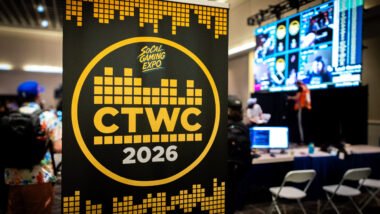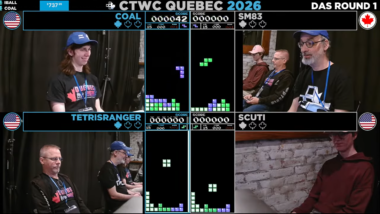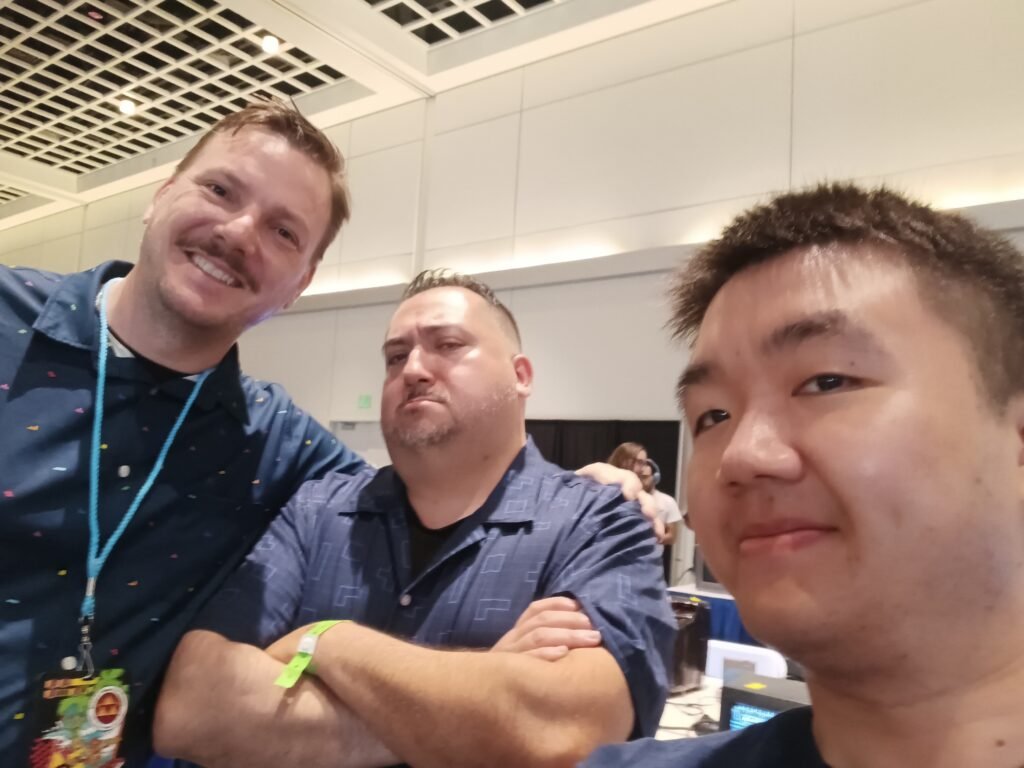
It was a Thursday, the day before the tournament began. This was the day where volunteers set up the stage.
I decided to show up before 12 PM to help out.
This was my third time at CTWC, I was already feeling comfortable around some of the players that I’ve met before at previous tournaments. Those that I met for the first time had already recognized me from the CTWC Discord server because I chat regularly and use my face as a profile picture.
It still amazes me how much calmer I was around the players compared to my very first time here. I was already welcomed here and I was comfortable with who I was as a person. That means a lot to me, because I’ve had people judge me heavily for showing even a little bit of personality.
After we all helped out with setup, we took a lunch break. I sat with Vince Clemente (owner of CTWC), Kingsman (one of the main organizers of CTWC), and Danny Cox (Owner of Classic Tetris Network and Blue Scuti’s Uncle). Vince let me know that I was going to countdown the first Qualifying session as I was a screamer last year.
When I finished my sandwich, I went to one of the game stations to get some practice in. I did some Level 19 starts on the NES console and CRT TV. Yes, I’m talking about those old TVs that are heavy to carry around. Many highly skilled players play on CRT TVs because it has less input lag than a flat screen monitor.
That input lag is noticeable on Level 19. I had been practicing NES Tetris on the Nintendo Switch for a few weeks beforehand. When I practiced on a CRT TV, my timing was off on Level 19. It took a while for me to get used to the different timing. It was important for me to survive this level because it can mean the difference between making it or not making the Bronze bracket.
I took a break from practicing to chat with others. I talked to Gunter about his role in organizing the CTWC France Regional. This was his first time at CTWC which meant it was our first time meeting each other in-person. He was thanking me for the stats work that I’ve been doing.
I brought up that the France Regional had a unique bracket. Particularly, it’s a 8-player wide flat bracket, resulting in more rounds, with only 4 matches in each round. While other CTWC Regionals in Europe have a wider bracket, a 16-player wide flat bracket, with 8 matches in each round. Gunter explained to me that the number of matches were still the same between those different bracket formats, so he went with the thinner bracket to make the matches more competitive.
While Gunter and I were chatting, we saw Blue Scuti. The last time Gunter met Blue Scuti in-person was at the France Regional back in 2024. When Gunter got to meet him again, Blue Scuti looked a bit different.
When I first met Scuti at the 2024 CTWC, I was slightly taller than him. Now he was taller than me.
Staff Meeting
Eventually, the volunteers circled around Kingsman and Arbaro. The most important topics discussed were the roles of Qualifying judge and Bracket referee.
The new qualifying format meant there was a change in how we recorded the scores. We still filled out scorecards to give to the stats team. But we also kept track of scores with a paper and clipboard that would be provided by Arbaro, who was the head referee.
The paper had a template where we filled out the player’s name and the scores they submitted. We also filled out how many qualifier points they earned from each score submission along with their total qualifier points. After each submission, we let the player know their total qualifier points. That paper helps us keep track of everything, it also acts as a failsafe if scorecards fail to make it to the stats team.
Another topic discussed was the player’s responsibility in submitting scores. Last year, there was a situation where a player scored a maxout during their qualifying run, but didn’t raise their hand to submit their score. The player was assigned to a game station that was livestreamed, so their games were recorded. Their maxout was accepted because it was on video, even though the player didn’t raise their hand.
A new rule was set this year, making it clear that a player must raise their hand in order to get their score submitted. If the player does not get their score submitted by a qualifying judge, that score will not count even if there is video footage. The organizers had emailed the players about this new rule a few days before the tournament.
The new qualifying format meant that there was a set of custom cartridges used for the Qualifying round. The custom cartridges were necessary to have scores uncapped so that scores above a maxout will be displayed.
A feature that was also added to the cartridge was the displaying of the past few scores, so that judges and referees can verify that the score that they had written down were correct.
Kitaru, who had created the cartridges for CTWC internal use, had created an internal video for the staff to know how to navigate the game within it. The cartridge had a “qual mode”, the judges had to make sure the game was set to “qual mode” when the player’s qualifying session would begin within 3 minutes. “Qual mode” forced players to start on Levels 0-19, which is what players could do on a vanilla (unmodified) game. There was also a rocket screen at the end of games to keep it consistent with the vanilla gameplay.
The next topic discussed was refereeing the tournament matches.
Last year, there was an incident where a player was distracted by their opponent, causing them to lose the game. Ultimately, organizers decided that the game would not count after reviewing the footage of the incident.
This time, Arbaro was the designated head referee. Arbaro and the other referees would be in charge of making rulings when incidents happen during the matches. That way, people aren’t hounding the organizers, who may not be watching the matches at the time because they are busy with other behind the scenes work.
Another point of topic was generating the piece sets the players were getting. The custom cartridge had 9,999 piece sets. The referee would generate a random number between 1-9,999. This could be done within the game itself or through random.org. (The piece sequences in each set were different each year.)
Arbaro had created a document with detailed instructions for the staff to look at as well.
When the staff meeting was over, I went back to practicing for my qualifying run. Eventually, I went back to where I was staying so that I could wake up the next morning for the tournament.